My Florida Solar Company Went Out of Business: What Next?

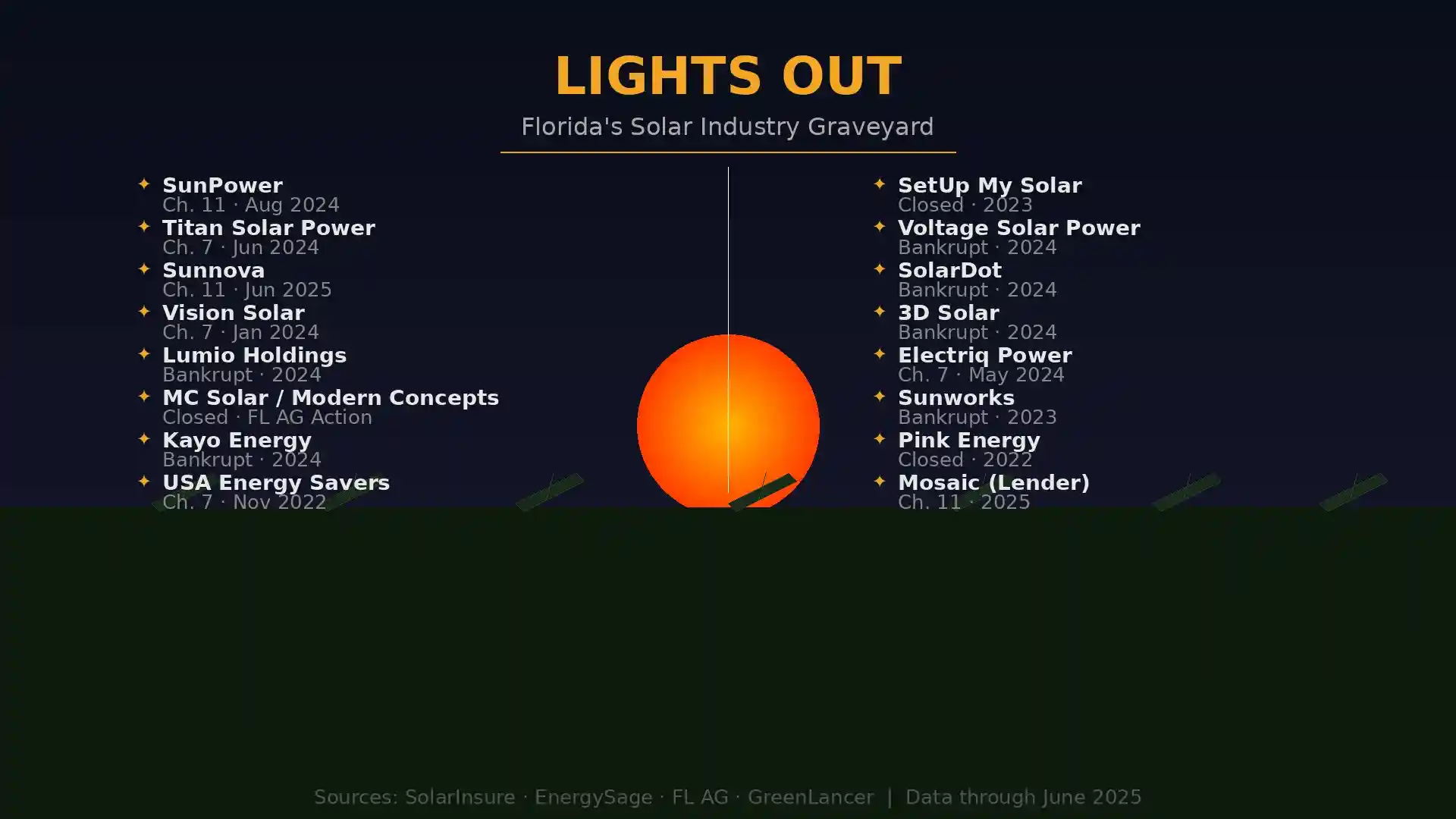

If your Florida solar company went out of business, the best first step is to conduct a complete 'solar system audit.' This involves gathering your contracts and warranties to understand your rights, diagnosing the health of your equipment, and clarifying your financing terms to protect your long-term solar investment.
The Sinking Feeling: Your Solar Installer Is Gone. What Now?
It’s a scenario playing out across Florida, from Tampa to Jacksonville. You invested in clean, renewable energy, envisioning lower utility bills from FPL or Duke Energy Florida for decades to come. Then, you discover the solar installation company you trusted has closed its doors. The phone number is disconnected, the website is gone, and you're left with a high-tech system on your roof and a bundle of unanswered questions. You've become one of the many orphaned solar clients in Florida.
This feeling of being stranded is unsettling, but it is not a dead end. Many homeowners immediately search for a local solar repair company to fix a pressing issue. While understandable, this can be a short-sighted move. For Florida homeowners 'orphaned' by a defunct solar company, the solution isn't simply finding a new repair service; it's about executing a 'solar system audit' to diagnose the health of your equipment, the validity of your warranties, and the terms of your financing to salvage your long-term investment.
Step 1: Assemble Your 'Solar Bill of Rights'
Before you make a single call, your first action is to gather the critical documents that define your power in this situation. Think of this as your personal 'Solar Bill of Rights.' These papers contain the answers to who is responsible for what and outline the path forward. Find a folder and collect the following:
- Installation Contract: This is the agreement with the defunct solar installer. It details the scope of their work and, most importantly, the terms of their workmanship warranty. While that specific warranty may now be void, the contract is still a crucial record of what was installed and promised.
- Financing Agreement: Did you get a loan, a Power Purchase Agreement (PPA), or a solar lease agreement? This document is with a third-party finance company, not the installer. It governs your payments and is almost certainly still active.
- Warranty Certificates: Your solar energy system is a collection of components, each with its own warranty. You should have separate documents for your solar panels (from manufacturers like Q Cells, Longi Solar, or SunPower), your inverter manufacturer (like SolarEdge or Enphase), and potentially your solar racking system.
- Net Metering Agreement: This is your contract with your local utility, such as Tampa Electric Company (TECO), which outlines how you get credit for the excess power your panels produce.
- System Design & Permits: These show the original plans and prove the system was permitted by your local municipality, whether in Miami or a smaller Florida community.
Having these documents ready will empower you to have intelligent, productive conversations with manufacturers and potential new service providers.
Decoding Your Warranties: The Installer vs. The Manufacturer
Understanding your warranty coverage is the most critical step in protecting your investment. There are two primary types of warranties you need to know about.
First is the Workmanship Warranty. This was provided by your original solar company and covered issues related to the quality of the installation—things like leaks, loose wiring, or improperly mounted equipment. Unfortunately, with an out of business solar installer, this warranty is likely unenforceable. A workmanship warranty claim against a company that no longer exists is rarely fruitful.
However, your most valuable asset now is the Manufacturer's Warranty, also known as the equipment manufacturer warranty. This covers the physical hardware itself. Your solar panels typically have a 25-year performance guarantee, and your solar inverter warranty might be for 10 to 25 years. These warranties are held by large, stable companies.
To make a direct warranty claim process with the manufacturer, you'll need the model and serial numbers of the faulty equipment. But there is a major catch. If you don’t have a certified installer working on your system, the equipment manufacturer's warranties could be determined to be void. This is why you cannot simply hire any roofer or electrician for troubleshooting solar panels. Attempting a DIY solar inverter repair or having an unqualified person perform a solar panel removal service could be a costly mistake.
The Financing Trap: Navigating Your Loan or Lease
One of the most immediate questions for orphaned solar clients is, "Do you still have to pay if a solar company goes out of business?" In almost every case, the answer is yes.
Your solar loan servicer is a separate financial institution. Your obligation to them is independent of the solar company's operational status. You must continue making payments. If your system is underperforming and you stop paying, you risk defaulting on your loan, which can damage your credit and potentially lead to a Uniform Commercial Code (UCC) filing or even a mechanic's lien on your property.
The situation differs slightly depending on your agreement:
- If you have a solar loan: You own the residential solar system. You are responsible for its maintenance. Your best course of action is to contact your loan servicer, explain the situation with the defunct solar installer, and see if they have a network of approved service partners.
- If you have a PPA or solar lease: You do not own the equipment. The company that holds the lease is responsible for maintenance. If you have a solar lease or PPA from a bankrupt company, the company that owns the system is responsible for maintenance, and these agreements are typically transferred to an acquiring company. You will need to identify which company now services your agreement and contact them for any needed solar system repair.
Trying to get out of solar panel debt or a contract is extremely difficult in Florida. Unless there was a clear breach of contract or fraud, you are generally bound by the terms you signed. If you suspect fraud, you should contact the Florida Attorney General's office.
Hiring a 'Solar Doctor,' Not Just a Repairman
When your system fails, the temptation is to find the quickest fix. But orphaned solar systems often have underlying issues that a simple repair won't solve. The original company may have cut corners, leading to premature equipment failure. This is why you need a 'Solar Doctor'—a company that specializes in solar equipment diagnosis and servicing orphaned systems, not just selling new ones.
Reactive Repair Service vs. Proactive System Audit
Choosing the right approach is key to the long-term health of your solar power investment. Let's compare the options.
Reactive Repair Service This approach focuses on fixing the immediate, obvious problem. For example, if your inverter is showing an error code, a repair service will focus solely on that inverter.
- Pros: Can be a faster and cheaper initial fix for a single, isolated issue.
- Cons: It's like putting a bandage on a broken arm. It doesn't address potential root causes, like faulty wiring or improper installation, that led to the failure. This can lead to recurring problems and may even void your manufacturer's warranty if not done by a certified technician.
Proactive System Audit This is a comprehensive, top-to-bottom solar system inspection. A certified technician examines every component: the panels, the microinverter or string inverter, the solar racking system, wiring, connections, and even your solar monitoring system to ensure everything is performing as it should.
- Pros: Identifies and corrects hidden installation flaws, ensures all equipment is operating safely and efficiently, and provides the documentation needed for any manufacturer warranty claim. It secures the long-term value of your investment.
- Cons: This solar operations and maintenance (O&M) approach is more thorough and may have a higher upfront cost than a simple service call.
Vetting Your New Solar Partner in Florida
When searching for a company to perform a solar system takeover and provide ongoing service, you need to be selective. Look for an established Operations and Maintenance (O&M) provider with deep roots in Florida. A key indicator of trust is their team. As one of our clients noted after their original installer vanished, “The technician was out the same day — he did repairs and sent me numerous pictures.” That’s the level of service you deserve.
Here’s what to look for:
- State Licensing: This is non-negotiable. In Florida, state certification (licensure) for solar contractors is required for anyone performing repairs, maintenance, or replacement of any solar PV systems.
- Certifications: Ask if their team includes a NABCEP Certified Professional. This is the gold standard for competency in the solar industry.
- Equipment Expertise: Do they have documented experience with your specific hardware, whether it's LG Solar panels, a Tesla Powerwall battery storage system, or Enphase microinverter repair?
- Local Reputation: Check their reviews with the Better Business Bureau (BBB) and other online platforms. Do they have a track record of helping customers in South Florida or the Orlando area?
- Avoid Scams: Be wary of unsolicited offers. Remember, the federal government does not install solar systems in homes for free; offers claiming otherwise are scams that 'orphaned' homeowners may be vulnerable to.
Making the Right Choice for Your Needs
The right path forward depends on your immediate situation and long-term goals. Here is tailored advice for different types of orphaned solar clients.
For the 'Crisis Mode' Homeowner
Your system is down or your utility bill has spiked, and you're losing money every day. Your priority is to get your system back online, but you're worried about high costs and voiding warranties. Your best move is to engage a certified 'Solar Doctor' for an immediate and comprehensive solar equipment diagnosis. A quick fix might seem appealing, but an audit will ensure the repair is valid for warranty purposes and that another component isn't about to fail. You need a company that understands urgency without sacrificing quality.
For the 'Proactive Planner'
Your system is working fine, but you've learned your installer is gone, and you feel unprotected. You want to ensure your significant investment is safe before a problem arises. For you, a proactive solar system audit is the perfect tool. It's a health check-up for your system that can catch small issues before they become expensive failures. This is your opportunity to establish a service relationship with a reliable, local solar company that will be there for you for the next 20+ years.
For the 'Financially-Focused' Homeowner
Your primary concern is the loan or lease payment you're making every month. You need to know who holds the contract and what your rights and obligations are. Your first step is to pull out that financing agreement and identify the solar loan servicer or PPA owner. Contact them directly. If you have a loan and believe the system isn't producing the energy it should, a professional system audit provides the third-party data you need to build a case with the finance company. Proof of professional process is key, and a company that can deliver that is invaluable. As one of our happy customers said, we “Installed in ONE DAY, and passed inspection the NEXT DAY.” That efficiency and adherence to standards protects everyone involved.
At the end of the day, navigating an abandoned solar project requires a clear, strategic plan, not a panicked reaction. By understanding your documents, warranties, and financing, you can move from a position of weakness to one of strength. For a comprehensive solar system audit from a trusted, licensed Florida team, contact Solar Bear today. We are here to adopt your system and protect your investment for the long haul.