How Solar Panels Affect Your Florida Homeowners Insurance


Yes, installing solar panels in Florida can significantly affect your homeowners insurance, potentially leading to increased premiums or even non-renewal. The impact depends less on the panels themselves and more on your roof's age, the installation quality, and your insurance carrier's specific underwriting guidelines for renewable energy systems.
The Florida Insurance Paradox: A Smart Upgrade Meets a Volatile Market
Going solar is one of the most powerful decisions a Florida homeowner can make. It promises lower utility bills, increased home equity, and a step towards energy independence. Yet, in the Sunshine State, this forward-thinking upgrade introduces a critical paradox. In a state where many homeowners are facing rising insurance costs and carriers are dropping policies by the thousands, the very act of improving your home can make it harder to insure.
Why does this happen? For insurance companies navigating Florida’s high-risk environment, any modification to the roof is a red flag. The roof is your home's first line of defense against hurricanes, and insurers see any penetration or addition to this structure as a new potential point of failure. A solar panel installation, in their eyes, isn't just an energy asset; it's a new variable in their risk calculation, one that involves wind loads, water intrusion, and potential for expensive property damage during a storm.
Beyond Panel Value: What Your Insurer Really Cares About
When you inform your insurance company that you’re adding a rooftop solar system, their primary concern isn't the replacement cost value of the panels. Their underwriting process is focused on a much bigger picture: how the solar panel installation affects the overall integrity of your home.
Here are the real factors that determine your home's insurability after going solar:
- Your Roof's Age and Condition: This is the number one hurdle. Most insurance companies in Florida will not write a new policy or even renew an existing one for a home with a roof over 10-15 years old. If you install a brand-new, multi-thousand-dollar photovoltaic (PV) system on a 12-year-old roof, you are almost guaranteeing an insurance nightmare. The carrier sees a future roof replacement where they'll have to pay to remove and reinstall the entire solar energy system, a cost they refuse to bear.
- Quality of Installation: The method of installation is scrutinized heavily. Does the installer adhere to the latest Florida Building Code for hurricane-force winds? Are the mounting systems and flashings engineered to prevent water intrusion? Subpar workmanship can turn a solar array into a liability. The Insurance Institute for Business & Home Safety (IBHS) warns that solar panels and arrays that fail or become detached can cause extensive damage to roofs and can become flying debris, creating a significant hazard.
- Installer's Credentials: An insurer wants to see that your system was installed by qualified, professional installers. A company that holds licenses in both roofing and solar provides a level of assurance that others cannot. It proves that the team understands the complete building envelope—not just the electrical components, but the structural integrity of the roof they are mounting to. This dual certification can be a critical factor in getting your new coverage approved.
Answering Your Top Solar & Insurance Questions
Do solar panels increase home insurance in Florida?
They certainly can. You will need to increase your dwelling coverage (also known as Coverage A) to account for the added home value from the solar panels. This increased coverage limit will naturally lead to a higher insurance premium. More importantly, if your roof is older or your carrier is wary of solar, they may increase your premium substantially due to perceived liability risk or even drop your policy altogether, forcing you into a more expensive market.
Why is it so hard to sell a house with solar panels?
This challenge often stems from two issues. The first is a solar lease agreement or Power Purchase Agreement (PPA), where a third party owns the system. This can complicate the sale, as the new buyer must qualify to take over the agreement. The second, more relevant issue in Florida, is insurability. If a potential buyer's preferred insurer (like Allstate or Progressive) refuses to write a policy for the home because of the solar system or the roof's age, it can kill the deal. Proactively solving the insurance question before listing your home is key.
Why is my electric bill so high if I have solar?
A higher-than-expected bill from your utility company after going solar usually points to one of three things: your consumption has increased, your system is underproducing due to technical issues like inverter damage, or your system was undersized from the start. It’s also important to understand net metering policies and fixed fees from the utility that you will always have to pay to remain connected to the power grid.
What is the 33% rule in solar panels?
There is no universal "33% rule" in the solar industry. This is likely a reference to a specific local utility company's policy, a particular financing requirement, or a misunderstanding of the Federal Solar Tax Credit (which is currently 30%, not 33%). Always clarify such "rules" with your installer, as they are not standard across Florida or the nation.
Key Factors for a Bulletproof Solar Project
To avoid being trapped with an uninsurable home improvement, you must treat your insurance as a critical part of the planning process. Here are the factors that will make or break your project.
Impact on Your Current Home Insurance Policy
This is your first call. Before you sign any contract, speak directly with your current insurance agent. Do not just ask "Do you cover solar panels?" Ask specific questions: "What are your underwriting guidelines for a rooftop solar system?", "What are your requirements for roof age?", "Will this affect my hurricane coverage or my deductible?", and "Will my policy be renewed?" Getting these answers in writing is essential.
Installer's Certifications and Insurance
Verify that your solar installer is, at a minimum, state-licensed and insured. For maximum peace of mind, choose an installer who is also a licensed roofing contractor. This dual expertise is your best defense against roof damage and water intrusion. Ask for their Certificate of Insurance (COI) to ensure they carry sufficient liability coverage. It’s this attention to detail that makes a difference. One of our customers recently noted, “Very rarely can you say a process could not have gone better — this is definitely one of those times.” This is the standard you should expect.
Hardware Quality and Wind-Resistance
Not all solar panels and mounting hardware are created equal. In Florida, you need a system specifically engineered and tested to withstand hurricane-force winds. Ask for the technical specifications and wind-load ratings of the equipment. This documentation will be vital when proving to your insurer that your system reduces, rather than increases, risk.
Comprehensive Warranties
A robust solar panel warranty is important, but the workmanship warranty is paramount. You need a guarantee that covers not just the equipment but the labor and, most critically, any penetrations made to your roof. A 10- to 25-year warranty that explicitly covers roof leaks from the installation is non-negotiable.
Availability of Solar-Friendly Insurance Carriers
If your current carrier gives you trouble, you need to know your options. Don't wait until your policy is cancelled. The Florida Solar Energy Industries Association (FlaSEIA) notes that some insurance carriers are more accommodating than others. Companies like Citizens Property Insurance Corporation (often the insurer of last resort), USAA, and Tower Hill Insurance have a reputation for being more familiar with solar. Exploring quotes from these companies before you commit can save you from a major headache.
From Liability to Asset: How to Frame Your Solar Project for Insurers
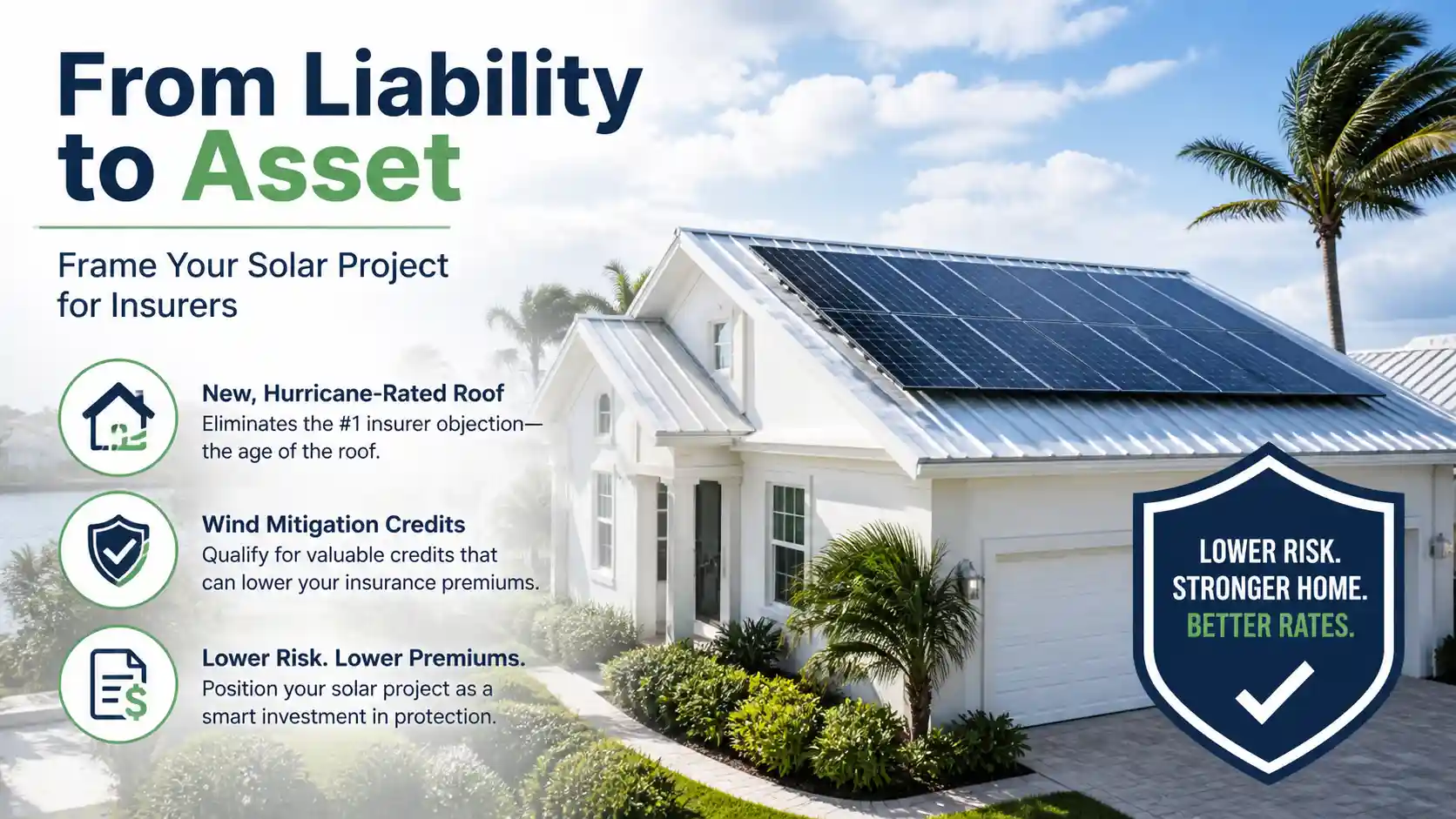
The key to navigating Florida's insurance market is to proactively frame your solar project as a risk-reduction strategy. Bundling a new, hurricane-rated roof with your solar panel installation is the single most effective way to do this. It eliminates the insurer's primary objection—the age of the roof—and often qualifies you for valuable wind mitigation credits, which can lower your insurance premiums.
Furthermore, an integrated project allows you to present the insurer with a complete package of engineering documents for both the roof and the photovoltaic system. This demonstrates a professional, holistic approach to home improvement. Adding features like solar battery storage enhances this narrative, positioning your home as a resilient asset that can maintain power during an outage, reducing the risk of secondary issues that can lead to an insurance claim.
And don't forget other forms of protection. While your home insurance policy may cover windstorm damage, it likely has policy exclusions for flooding. It's wise to know that the National Flood Insurance Program (NFIP) states that building property coverage includes solar energy equipment. Some forward-thinking homeowners also seek out what is known as a "green homeowners policy," which can help cover the cost of rebuilding to modern energy-efficient standards after a loss. These layers of protection, combined with the immediate savings on your utility bill, create a powerful return on investment (ROI). As one of our clients put it, “Waited until my first Duke bill arrived — could not be more happy with my decision to choose Solar Bear.”
Making the Right Choice for Your Needs
Ultimately, there is no single "best" path. The right strategy depends entirely on your personal goals, your property's specifics, and your risk tolerance.
- The Storm-Prepper: If your main goal is energy independence during hurricane season, your focus should be on system robustness. Prioritize a new, high-wind-rated roof as part of the project. Invest in top-tier mounting hardware and consider including solar battery storage. Your upfront cost will be higher, but the investment buys you resilience and makes your home far more attractive to insurance carriers.
- The Cost-Conscious Saver: If you are primarily motivated by escaping high utility bills, you must be extremely diligent about unexpected costs. Your first step is a firm, written confirmation from your current insurer about their policy on solar. If they indicate a significant premium increase or non-renewal, you must shop for new insurance and get quotes *before* you sign a solar contract. A "great deal" on solar is no deal at all if it doubles your homeowners insurance.
- The Eco-Investor: You see solar as a long-term upgrade to your property value and a commitment to renewable energy. Your priority is protecting that investment. You should absolutely work with a dually-licensed roofing and solar contractor. This ensures the structural and energy aspects are handled seamlessly. You are the ideal candidate for bundling a new roof with your solar, maximizing your home appraisal value and minimizing any potential insurance complications down the road.
Navigating the intersection of solar energy and homeowners insurance in Florida requires expertise in both fields. The key is to address the insurance question proactively, not as an afterthought. As a dually certified roofing and solar contractor based in Tampa, FL, we specialize in creating integrated roofing and solar systems that enhance your home's value and resilience while satisfying the stringent requirements of Florida's insurance market. For a personalized assessment of your home and a clear path forward, contact our expert team for a free, no-obligation quote today.